Gifu, Japan · The Northern Alps
Tattoo-Friendly Onsen in Okuhida: What to Confirm
For an Okuhida stay with tattoos, confirm the policy directly with the property for the exact bath you want to use. Private sessions and in-room baths may offer useful options, but they still need explicit approval. Keep the written reply with your room booking and check any conditions before arrival.
Some booking links may earn us a commission at no extra cost to you. How we fund this guide.
Can travellers with tattoos use onsen in Okuhida?
A tattoo does not give you one region-wide answer: obtain permission from the particular property for the particular bath you intend to use. This guide does not label any Okuhida facility as tattoo-friendly without a current, property-specific confirmation.
Japan National Tourism Organization guidance describes tattoo acceptance as varying between facilities. A communal bath, a reservable private bath and a bath attached to your room can involve different arrangements, even at the same accommodation. Treat those differences as questions to resolve before booking, rather than reasons to assume access will be allowed.
Our recommendation is to start with the bathing experience you need and request a written answer. If your main goal is bathing privately with a partner, search for that arrangement and ask about tattoos explicitly. If you want a large communal outdoor bath, ask about that exact facility rather than accepting a reply that only mentions the guest room.
A page titled “tattoo-friendly onsen” can easily encourage false confidence. Here, the useful outcome is a confirmed booking that suits you, not a long list built from old comments. Keep the Okuhida ryokan comparison open while checking locations and room categories, and regard every unconfirmed policy as unresolved.
Which bathing arrangement should you investigate first?
Investigate an in-room hot-spring bath or a private session if privacy is important, while still obtaining explicit policy confirmation. These arrangements can reduce uncertainty about sharing, but their existence alone is not permission to use them with tattoos.
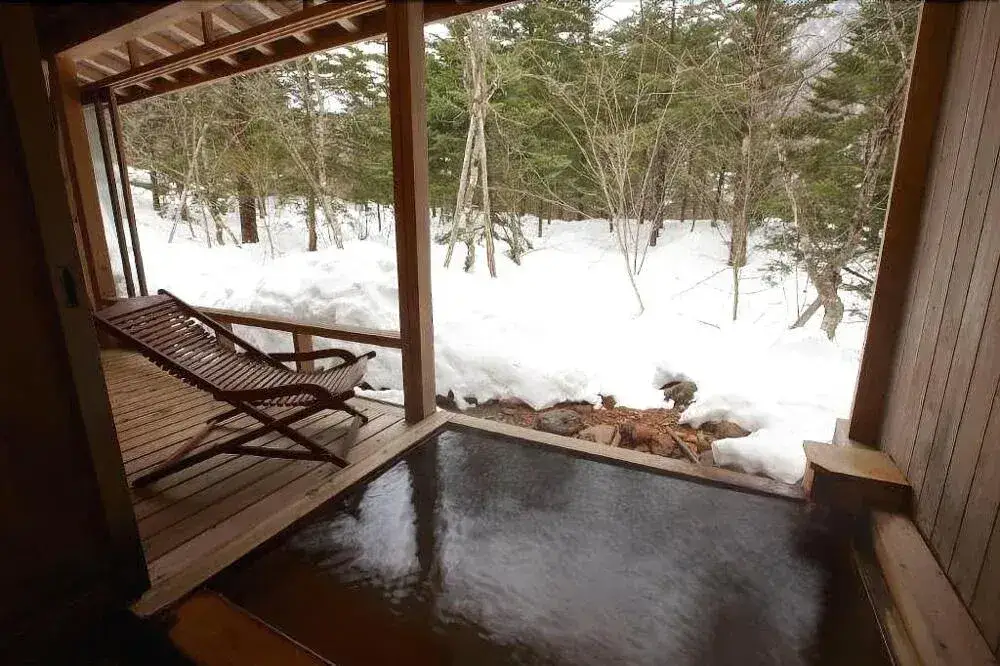
Be precise about terms. An en-suite bathroom can be an ordinary bathroom. “Private bath available” can mean a separate facility that is allocated through a reservation process. “Outdoor bath” describes the setting, not exclusive access. A photograph of a room with a bath does not establish that every room category has one.
The private-onsen accommodation guide is a starting point for those distinctions. Once you have identified an appropriate room or plan, ask the property whether a guest with your circumstances may use it and whether there are any restrictions. Save the reply alongside the booking confirmation so the scope remains clear.
Communal-bath access is a separate question. A property might answer a request for private use without confirming anything about shared facilities. If you want both experiences, ask both questions. If only private bathing is approved, decide whether that is sufficient before making a restrictive booking. Do not plan to test a broader interpretation at check-in.
What information should your enquiry contain?
Send a short request identifying the stay date, room or plan, and exact bathing area you wish to use. Include only the tattoo details necessary for the property to give an informed answer.
For example, explain whether the tattoo is small or extensive and whether you are asking about visible use, an approved covering or private bathing. You do not need to send personal photographs unsolicited. Ask the property what information it needs, and use the accommodation’s verified contact channel rather than an unconnected third-party messaging account.
A useful enquiry is: “We are considering the named room category for these dates. One guest has a tattoo. May that guest use the room’s hot-spring bath? May they use the communal baths? If a covering is required, what covering do you permit?” This separates permission, location and conditions instead of requesting a vague yes or no.
If children or other family members will use a private bath with you, add that question as well. Tattoo permission does not resolve age, capacity or family-use arrangements. The final booking should match the group who will actually arrive, not an imagined couple used to obtain a general answer.
Give the property time to reply before your cancellation deadline. An unanswered message is not permission. If the arrangement remains unclear, choose a booking with conditions you understand or investigate another property rather than hoping to negotiate after a long journey.
How should you interpret the reply?
Read the reply for its scope: which guest, which bath, which room and which conditions it covers. Ask one follow-up if the answer leaves any of those points ambiguous.
A response saying “private bath available” does not necessarily answer “Are tattooed guests allowed to use it?” A response saying “cover tattoos” does not establish what size, type or number of covers the facility accepts. A response about staying overnight does not automatically confirm day-use bathing access.
Confirm whether an approved private session must be reserved before arrival and whether your booking guarantees access. If the system only allocates sessions at check-in, decide whether that uncertainty is acceptable. You should not confuse the possibility of reserving a bath with a confirmed reservation at your preferred time.
When the answer is clear, retain it with the property’s name, date and the plan you chose. If you later change room category or travel dates, check whether the confirmation still applies. A permission given for one arrangement should not be reused as a permanent endorsement of every facility the property operates.
This is also why a personal recommendation can be useful but incomplete. Someone else’s successful visit can suggest a place to contact. It cannot tell you whether the same conditions apply to your tattoo, bath choice, dates and booking plan.
Are tattoo covers a dependable solution?
Use covers only when the particular facility confirms that it permits them and explains the applicable conditions. Buying a cover before travel does not create a right to enter a bath.
JNTO discusses coverings among possible approaches, while emphasising that facilities differ. For Okuhida planning, translate that into a specific enquiry about the bath you want to use. Do not rely on a general tourism article to override a sign or a reply from the operator.
Ask whether the facility provides or accepts a particular covering and whether your situation fits its rules. If it does not permit your proposed arrangement, choose a different confirmed option. Avoid planning around concealing the tattoo from staff; that leaves the central access question unresolved and can create an uncomfortable encounter for everyone.
A covering may also be irrelevant to the experience you want. If your priority is a relaxed private soak without managing a cover, focus your search there. The aim is to select an accommodation arrangement you are comfortable using, not to build a holiday around a workaround you already dislike.
If the property offers several bathing spaces, ask whether the covering rule applies to all of them. Do not assume that an indoor communal bath and a separate outdoor or mixed facility use the same policy merely because they share a reception desk.
Why do some onsen restrict tattoos, and does it mean you are unwelcome?
Restrictions are a facility policy, usually rooted in local custom, and they are not a judgement about you as a visitor. Japan’s tourism bodies describe the practice as widespread but varying between facilities, and some operators have relaxed their rules for visitors. Treat the policy as one more detail to confirm, in the same way that you would check a meal plan or an arrival arrangement.
The most useful attitude is practical and polite. Staff are applying the operator’s rule, and they may have limited discretion even when they would like to help. A clear, courteous enquiry gives them the information they need, while an argument at the bath entrance puts them in a difficult position. If the answer is no for the bath you wanted, ask whether another bathing arrangement is available rather than pressing for an exception.
It also helps to separate the rule for the bath from the welcome to the property. A ryokan can be happy to host you and still limit which facilities you can use, and the reverse can also be true. Look at what the full stay offers and decide whether it is worth booking on those terms. If bathing is the whole point of the trip, a different property or a stay with a confirmed private arrangement may be the more honest choice.
What about day-use baths and public facilities in Okuhida?
Check each facility separately, because a day-use bath, a village public bath and a ryokan’s overnight bathing area can each set their own tattoo rule. Do not assume that a facility that accepts day visitors uses the same policy as the inn next door, or that a ryokan’s guest policy extends to people who are not staying overnight. The official Okuhida tourism association lists accommodation and bathing information that you can use as a starting point, but its listing does not replace a direct answer.
If you plan to bathe between buses, ask before you travel whether day visitors are accepted, which bath is available and what the tattoo conditions are. Opening arrangements for day bathing can change, so treat an older blog post with caution. Where a facility does not reply, choose a plan that does not rely on it. A bath that you cannot confirm should not be the reason you leave the ryokan at a time that disrupts your transport.
For travellers combining several stops, keep a short list in your phone showing each facility, the answer you received and the date. That record is useful if staff change or the conditions are queried. The Hirayu Onsen guide and Okuhida ryokan guide help you compare the villages and the kinds of stays, but neither establishes a tattoo policy for any named bath.
How should you compare a shortlist of properties?
Compare confirmed bathing permission alongside location, room details and the meal plan. A reassuring policy is only one part of whether the stay works for the trip.
Make a simple shortlist with the exact room, confirmed bath access, any conditions and the date of the reply. Add the nearest arrival stop and the latest acceptable dinner arrival. This helps prevent a property with a convenient bath arrangement from becoming an inconvenient transport choice.
| Shortlist question | Useful evidence | Still unresolved when |
|---|---|---|
| Can the tattooed guest bathe? | Direct answer for the intended bath | The reply only says guests may stay |
| Is the bath private? | Exact room or session arrangement | A photograph is the only evidence |
| Are covers required? | Facility’s stated condition | A general article suggests using one |
| Is access guaranteed? | Confirmation for your booking | Sessions are merely described as available |
| Does the stay fit the journey? | Arrival stop and meal arrangement | You have only compared room images |
For a bus-based visit, Hirayu Onsen may be worth investigating for its role in the transport network, but village convenience is not evidence of tattoo acceptance. The same distinction applies to every other Okuhida village: choose the area for the trip, then verify the facility’s rules.
For couples, ask whether both guests can share the approved private space. For a group, clarify whether the answer covers everyone who needs access. Keep assumptions out of the final comparison; a shorter list with clear answers is more useful than a broad list whose most important feature remains uncertain.
What should you do at arrival and before bathing?
Mention the confirmed arrangement discreetly at check-in and ask staff to explain any booking steps. Keep the conversation practical and specific rather than treating the earlier reply as permission to ignore the property’s current instructions.
If a discrepancy appears, show the confirmation and ask which arrangement is available. Resolve the uncertainty before entering the changing room. A calm discussion at reception gives staff a chance to explain or help; discovering the issue inside the bath leaves fewer comfortable options.
Follow the ordinary onsen etiquette regardless of tattoo permission. Approval to use a facility does not change expectations about washing, towels, photography, noise or supervision. A private bath also has instructions for entry, use and leaving the space ready for the next guest.
If the confirmed arrangement is no longer available, ask the property about an appropriate alternative and the implications for your booking. Avoid promising yourself that a particular outcome is guaranteed by a general travel guide. Keep records and use the actual accommodation or seller support channel for any booking dispute.
How should you plan when no suitable policy is confirmed?
Keep the accommodation search open, or book a stay whose value does not depend on unconfirmed bathing access. You do not need to force a communal onsen visit into the itinerary to make the trip worthwhile.
Separate a desire to stay in Okuhida from a requirement to use one particular bath. A suitable room, meal and mountain location may still fit the trip, but only if you knowingly accept the bathing limits. If the onsen is the main reason for travelling, do not settle for ambiguity merely because a room is available.
Leave yourself time to investigate another property before committing to transport with restrictive change conditions. If a friend or an online directory suggests a new candidate, use that suggestion as the next enquiry rather than as verified permission. Policies should be confirmed at the point when they matter to your own booking.
The practical goal is straightforward: arrive knowing which bath you may use and how it works. That clarity lets the stay centre on the room, meal and mountain setting instead of an avoidable conversation about access at the end of the journey.
How should couples and mixed groups handle different preferences?
Agree before booking whether everyone needs the same bathing arrangement, or whether one guest can use a private bath while another is comfortable with a communal space. Mixed preferences are common, and a property may approve different options for different people.
Send one enquiry that names every guest who needs access and the baths each person hopes to use. Ask whether a couple can share a private session, whether a tattooed guest may use only the room bath, and whether anyone without tattoos may still use communal facilities. A single vague yes is not enough when the party will split across spaces.
If only one arrangement is approved, decide whether that still makes the stay worthwhile. Some travellers are happy with a private soak for the tattooed guest and a communal bath for others; some want everyone together. Neither preference is wrong, but it should be chosen deliberately. The private-onsen guide helps you compare formats before you contact the inn.
Keep the written reply with names, dates and the room category. If you later add a guest or change rooms, ask again. Permission for one person and one bath does not automatically cover a larger group or a different plan.
What should you pack when tattoo rules are still being confirmed?
Pack for the trip you can enjoy even if bathing access is narrower than hoped, and keep any covering materials optional until the property confirms them. Do not build the suitcase around a workaround the facility has not approved.
Bring ordinary bathing essentials and follow the onsen etiquette guidance once access is clear. If the property asks for a specific covering, use the type it names rather than improvising with unrelated products. Leave cameras and phones out of changing and bathing areas regardless of tattoo policy.
Carry the confirmation offline: property name, room or plan, bath permission and any conditions. A screenshot or saved email is more useful at reception than a vague memory of a chat reply. If you still have unanswered questions a few days before travel, send one short follow-up rather than waiting until check-in.
Finally, keep the rest of the Okuhida plan intact. A mountain village stay can still be rewarding for the room, meals and scenery when bathing arrangements are limited, provided you chose that trade-off knowingly. If the onsen itself is the reason for the trip, leave time to change the booking before transport becomes hard to adjust.
Your questions, answered
Which Okuhida ryokan definitely allows tattoos?
This guide does not give any property a confirmed tattoo-friendly label without a current answer for the intended bath. Contact the accommodation directly with your room category and bathing request. Keep the reply and any conditions with the booking. A past visitor’s experience is useful as a lead, rather than permission for every future stay.
Does booking a private onsen automatically solve the issue?
A private arrangement may suit you, but confirm permission explicitly. Ask whether the exact in-room bath or reservable session is available to a guest with tattoos and whether any conditions apply. Also check how the session is booked and whether access is guaranteed, rather than assuming a property-wide private-bath description answers everything.
Can I cover a tattoo to use a communal bath?
Only rely on covering when the facility confirms that your proposed arrangement is acceptable. Ask what type of covering it permits and whether the rule applies to the bath you intend to use. A cover bought elsewhere does not override the operator’s policy, and a generic tourism suggestion is not a property-specific approval.
Should I send the hotel a photograph of my tattoo?
Start with a concise written description and ask what information the property needs. Do not send personal photographs unsolicited or through an unverified contact account. Identify the room, date and bath you are asking about so the reply has a clear scope. Keep only the personal information necessary to obtain an accurate answer.
What if staff give a different answer when I arrive?
Pause before entering the bath, show the written confirmation and ask staff to clarify which arrangement is available. Discuss any alternative through the property or booking seller as appropriate. Avoid treating a general guide as authority over the facility. Resolving the discrepancy at reception is more comfortable than discovering it in a shared changing area.
Do onsen restrict tattoos because visitors are unwelcome?
No, it is a facility policy rather than a judgement about visitors, and policies vary between operators. Staff may have limited discretion, so a courteous written enquiry before booking works better than a discussion at the bath entrance. If the answer is no, ask about another bathing arrangement or choose a different property.
Do day-use baths follow the same tattoo rules as ryokan stays?
Treat day-use and overnight stays as separate facilities with their own rules. A ryokan reply does not cover a public bath, and a day-use answer does not cover your room category. Contact each operator for the exact bath you plan to use, and keep that reply with the rest of your trip notes.