Gifu, Japan · The Northern Alps
Matsumoto to Okuhida: Hirayu Bus Guide 2026
Take the reserved Matsumoto–Takayama coach to Hirayu Onsen, then continue to your Okuhida village if needed. Check the current service and booking instructions before travelling, and allow time between Matsumoto Station and the bus terminal. Hirayu is the main connection to plan around; do not assume every bus continues toward Shinhotaka.
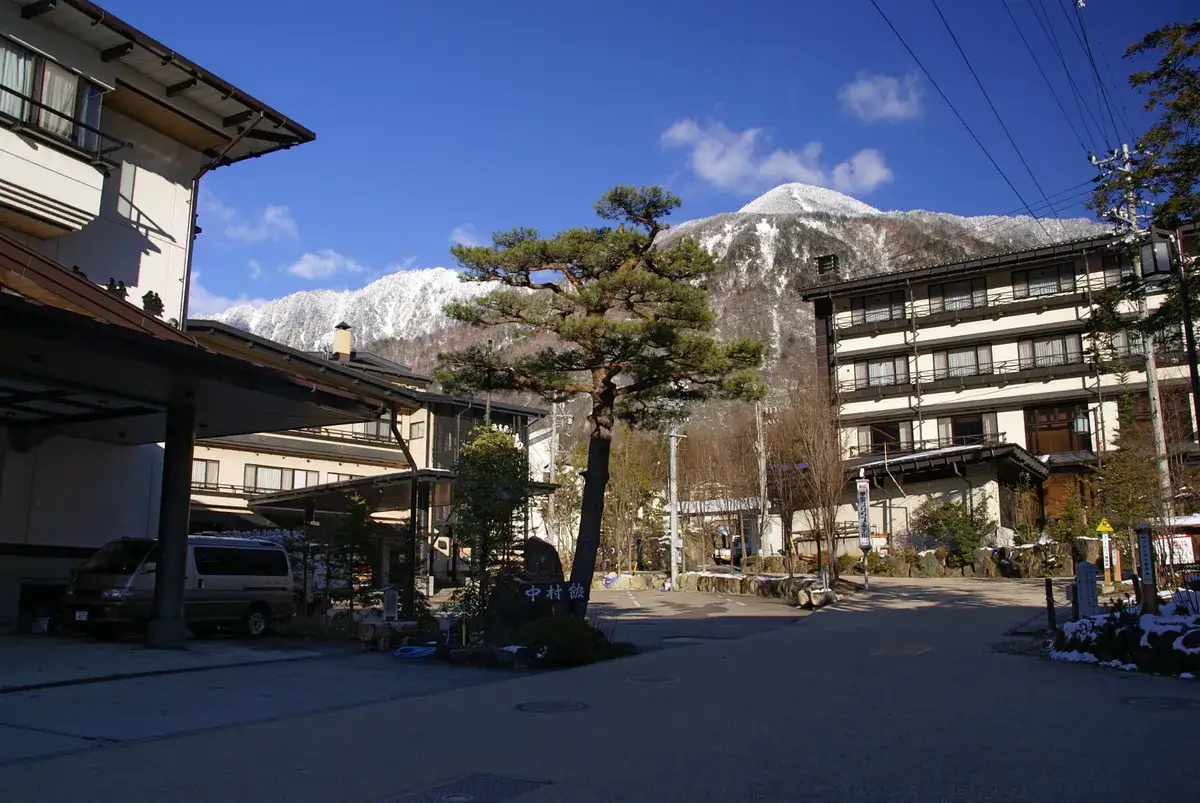
Archive view of Hirayu Onsen beneath snow-covered mountains; buildings and streets may have changed. · 663highland · CC BY 2.5 · Wikimedia Commons · Resized and converted to WebP
Some booking links may earn us a commission at no extra cost to you. How we fund this guide.
What is the clearest route from Matsumoto to Okuhida?
Use the Matsumoto–Hirayu road connection, with Hirayu as your arrival or transfer point. Nohi and Alpico publish this cross-mountain route; choose the service that fits your village and travel date rather than searching for a railway all the way to Okuhida.
Matsumoto is useful for travellers approaching from Tokyo on the eastern side of the Japan Alps. It also works as one end of a crossing itinerary that continues through Okuhida to Takayama. The value of that route is its shape: you can arrange the accommodation between two gateway cities rather than automatically returning to the city you started from.
Begin with your accommodation’s village and arrival instructions. If the stay is in Hirayu, the cross-mountain bus may complete the main transport task. If it is elsewhere in Okuhida, you still need to plan the local leg and final approach.
The Okuhida overview helps distinguish the five villages. Choose a base that fits the wider journey as well as the room you want, especially when your next destination is on the other side of the mountains.
Do you need to reserve the Matsumoto–Hirayu bus?
Yes: the current Nohi Matsumoto route page requires reservations. Check the operator’s live booking instructions for your date and route section, because older travel reports may describe a previous arrangement that is no longer appropriate.
Start the booking with the correct boarding point and destination. A seat to Takayama is not automatically the same booking as a seat to Hirayu, even when the places appear on the same route. Confirm the stop shown on the reservation and keep the full confirmation accessible.
Read any payment, collection or change conditions before completing the plan. If you are meeting a train, choose a comfortable connection rather than purchasing a coach departure that leaves no room to reach the terminal. A reserved service needs the party ready at the actual boarding point.
For a family, check how the operator treats each child and any infant, including seating. Do not assume rules match another local bus or a railway service. Give the operator the child’s relevant details when asking rather than requesting a broad explanation of all possible ticket categories.
Where do you board in Matsumoto?
Use the boarding point confirmed for your service, commonly Matsumoto Bus Terminal, and verify the current bay when you arrive. The railway station and bus terminal are separate places in the transfer process, even when both are shown within the same central area.
If you arrive by train, plan enough time to exit the station, orient yourself and find the coach departure. A planner’s walking estimate does not include unfamiliar signs, luggage handling or checking a reservation. Travelling with a group adds coordination time as well.
The official route pages include stop-location information, but Nohi cautions that map pins are approximate and the exact stop should be checked on site. Use the map to reach the correct area and the terminal information to finish the task.
Save the terminal name and Hirayu destination on your phone. If you are uncertain, show the reservation rather than only saying Takayama or Okuhida. A clear destination lets staff distinguish your service from a different sightseeing or regional departure.
How do you read the timetable and seasonal notes?
Read one service column from the Matsumoto departure to the Hirayu arrival, then check every symbol and operating-period note attached to it. Do not assume all columns have the same destination or operate on the same dates.
The route information can include special services toward Shinhotaka alongside the regular cross-mountain pattern. Treat any through option as something to verify for the selected date rather than a standard continuation available whenever you arrive.
| Arrival plan | What you need to check | What follows |
|---|---|---|
| Stay in Hirayu | Correct arrival point and property directions | Walk or confirmed property arrangement |
| Continue deeper into Okuhida | Separate local bus departure | Correct village stop |
| Use a listed through service | Actual operating date and destination | Confirm precise stop served |
| Continue to Takayama first | Whether it suits your itinerary | Avoid unnecessary backtracking |
Check the reverse-direction table as well. Even a one-way crossing plan benefits from understanding alternatives if the day changes. Save the official page, not just a cropped image of the outgoing time, so that notes remain available when you need them.
How do you change at Hirayu for the other villages?
At Hirayu, connect with the Nohi route toward the appropriate village and Shinhotaka. Identify the departure before travelling from Matsumoto, and leave a practical margin rather than relying on an immediate change shown by a route search.
The Takayama and Okuhida local-bus guide explains the regional stop pattern. Although you arrive from a different city, the same principle applies: choose the exact stop confirmed by the accommodation instead of using the broad village label alone.
Fukuchi, Shin-Hirayu, Tochio and Shin-Hotaka need their own final instructions. Ask the ryokan whether a particular stop or collection point is best, and tell it which bus you plan to take. A hotel’s short map distance from a road is not enough to establish a straightforward luggage approach.
If the connection requires a wait, make that part of the plan rather than an unwelcome surprise. Keep warm clothing and necessities accessible. If arriving in time for dinner depends on the first possible onward departure, consider an earlier coach from Matsumoto instead.
Should you add Kamikochi while crossing from Matsumoto?
Add Kamikochi only if its visitor season, transport and luggage arrangements fit the day. It is a separate destination requiring its own access plan, not a compulsory stop on the Matsumoto-to-Hirayu journey.
The ordinary visitor season is broadly mid-April to mid-November, with exact opening and closing information published by the official destination sources. Verify the current year and each facility rather than assuming a general seasonal description guarantees a particular visit.
A crossing day with a ryokan dinner is already constrained by several transport stages. If a Kamikochi walk is important, an overnight in Hirayu or a separate day can protect the time you want there. A hurried walk between reserved coaches may be less satisfying than arranging two clear sightseeing days.
Read the Kamikochi-from-Okuhida guide before adding it. Keep the onward mountain journey, the final village stop and luggage retrieval visible in the schedule rather than calculating only the time spent by the river.
Should you cross to Takayama or return to Matsumoto after your stay?
Cross to Takayama if your next stop lies to the west or you want to avoid retracing the same road; return to Matsumoto if you are heading back toward Tokyo or the east side. A crossing looks attractive on a map, but it only works when the ryokan departure, the bus connection and your onward booking fit together.
Look at both ends before reserving. A one-way crossing means your final-day schedule depends on a Takayama departure rather than the Matsumoto one you started from, and your bags travel with you across the range. Compare the Takayama arrival guide with the Japan Alps itinerary to see how a crossing fits a longer route. Returning the way you came gives you a familiar terminal and timetable, though you lose the variety. Neither choice is wrong; match it to the next hotel or long-distance ticket and check the 2026 notices for both directions.
What should you do if you reach Hirayu before check-in?
Ask the ryokan before you travel whether it can hold luggage, and plan a short, low-effort activity near the interchange rather than a major excursion. Reaching Hirayu before check-in is common on a crossing day, because a coach schedule rarely matches a property’s ordinary arrival time.
Confirm whether the property accepts bags early, where to leave them and whether they will be secure. Keep essentials in a small bag in case storage is not available. A short walk or a drink at a café can fill the gap, but check what is open on your date rather than assuming it. The Hirayu village guide and the Hirayu ryokan guide help you choose a base that suits an early arrival. If Kamikochi is in its visitor season, treat it as a separate day rather than a stop before check-in, as the Kamikochi season guide explains.
What should you know about luggage and mobility needs?
Ask the operator about equipment or luggage that needs special handling, and check the final property approach separately. A coach reservation establishes a seat, not unlimited baggage space or suitability for every mobility device.
Nohi’s current route page describes shared luggage storage and tells travellers to retain mobile batteries in the cabin rather than the luggage compartment. Read the full route-specific guidance shortly before travelling and ask about anything unusual.
Keep medicines, documents, warm layers and essentials for children with you. You may not be able to reach a bag in storage whenever you want during the journey. A small arrival bag reduces the need to unpack at a terminal or village stop.
For a wheelchair or stroller, explain dimensions, whether it folds and what assistance is needed. Ask the accommodation about the entrance as well. Transport suitability and hotel suitability are separate questions; both must work for the trip to be practical.
How should you plan a winter crossing?
Use the latest operator notices and build in flexibility for road conditions. The route crosses mountain terrain, so a clear forecast in Matsumoto does not establish the same conditions for the entire road or final village approach.
Keep arrival day simple and choose a bus with room before the accommodation’s dinner arrangements. If an earlier stage is delayed, contact the property with the revised plan rather than waiting until the expected arrival has passed. Ask what to do if the next connection becomes impractical.
Do not substitute an unfamiliar winter drive as a spontaneous backup. A rental vehicle requires appropriate equipment, a legally valid licence arrangement and a driver who is comfortable with the conditions. Transport flexibility is useful only when those parts are in place.
The Okuhida winter guide is the next planning step if the stay is in the snow season. Choose accommodation you will enjoy even if a ropeway outing changes, and avoid combining a weather-sensitive attraction with the last viable onward connection.
Is an overnight in Matsumoto worthwhile before continuing?
Consider it if your incoming train reaches the city late or if you want to avoid a pressured transfer into a meal-inclusive ryokan stay. A city overnight can make the next day’s mountain journey more predictable and leave more time at the accommodation.
Compare the cost in hotel changes with the benefit in usable time. Packing for an additional night is an inconvenience, but arriving late to a stay chosen for its evening meals and baths may undermine the reason for booking it.
If you stay in Matsumoto first, choose the next day’s bus before deciding how much sightseeing to do that morning. Keep luggage collection and terminal arrival in the plan. A slow start can be enjoyable when it is compatible with the reservation rather than something that gradually consumes the connection margin.
For a through trip from Tokyo, book the railway and bus together as an itinerary, even when purchased separately. The train should deliver you to a comfortable coach connection; a theoretically fast train is not useful when the next available reserved bus leaves much later.
What should your final route note contain?
Record the reserved coach, its boarding location, the Hirayu arrival and the onward village departure if needed. Include the ryokan’s preferred stop, contact details and any confirmed collection arrangement. Keep those practical details in one place alongside the original confirmations.
Check the following morning as well as arrival. Breakfast, checkout and the route to the next city need to fit together, particularly if you intend to leave via Takayama rather than return to Matsumoto. A crossing itinerary should remain clear in both directions.
Before travelling, review current route notices and save the official pages offline. The purpose is not to predict every possible disruption; it is to know which connection matters, who needs an update and what sensible alternative remains if the day changes.
How do you distinguish different Matsumoto-area services?
Use the exact route name and destination on the booking, because a bus connected with Kamikochi, Shirahone or Takayama may have different boarding and reservation arrangements. A general Japan Alps transport page is a useful starting point, not a ticket valid for every mountain route.
For the Okuhida arrival described here, retain the Matsumoto–Hirayu confirmation and the separate onward village information. If you change the plan to include another destination, check the new service from the beginning rather than applying the original booking rules to it.
This distinction is useful when reading older articles or screenshots that omit the full heading. Look for the operator, route, direction and date range together before treating a statement as relevant. If still uncertain, send the operator the precise journey you want to make. Asking whether one selected departure serves your required stop is easier to answer than asking for general advice about every bus around Matsumoto.
Your questions, answered
Do I need a reservation from Matsumoto to Hirayu?
The current Nohi Matsumoto route page requires reservations. Follow the operator’s instructions for the exact date, boarding point and destination. Older travel reports may describe a previous arrangement, so check the official booking process before reserving a train that depends on a particular onward coach.
Is Matsumoto Bus Terminal inside the railway station?
Treat the railway arrival and bus boarding as separate stages, with time to leave the station and find the confirmed terminal bay. Use the official stop information and check signs on arrival. A map’s walking estimate does not include luggage handling, unfamiliar directions or confirming the reserved departure.
Can I continue directly to Shinhotaka?
Check the selected service column and operating notes. The published cross-mountain information can include special through options, but these should not be assumed to operate for every date or departure. A planned change at Hirayu remains the main connection to examine when your accommodation is farther into Okuhida.
Can I visit Kamikochi on the way?
Only add it when the visitor season, transport and luggage arrangements leave enough time for the walk and your ryokan arrival. Kamikochi is a separate excursion with its own operating information. An overnight in Hirayu or a dedicated day may provide a more comfortable plan than fitting it between reserved connections.
Should I return to Matsumoto after my stay?
Choose the onward direction that fits the rest of the holiday. Continuing toward Takayama can suit a crossing itinerary, while returning east may be simpler for a Tokyo-bound trip. Check breakfast, checkout and the exact bus connections before booking the next long-distance service.
Does the Matsumoto to Hirayu route run in winter?
Check the operator’s current operating-period notes and notices for your travel date. Mountain routes can change in winter, and a service that runs in one season may not run in another. Use the official Nohi and Alpico pages, then build a flexible arrival with room for delays and a clear fallback if the day changes.
Is Matsumoto or the direct Tokyo coach better for Okuhida?
Choose Matsumoto if you want a train-led journey, a Matsumoto stop or a crossing to Takayama. Choose the direct Shinjuku coach to Hirayu if you prefer fewer changes. Compare the whole chain from your Tokyo starting point to your village stop, including reservations and the ryokan’s arrival time.